
Gallium-68 (Ga-68) is a radioactive isotope of gallium with a half-life of approximately 68 minutes. It decays to stable zinc-68 (Zn-68) by positron emission (about 89% of decays) and electron capture (about 11%), making it a valuable isotope for positron emission tomography (PET) imaging. Ga-68 is typically obtained from a germanium-68/gallium-68 generator, where it grows in as the decay product of germanium-68 (half-life 271 days); it is increasingly also produced directly in cyclotrons by proton irradiation of zinc-68 (Zn-68(p,n)Ga-68), often in liquid targets.
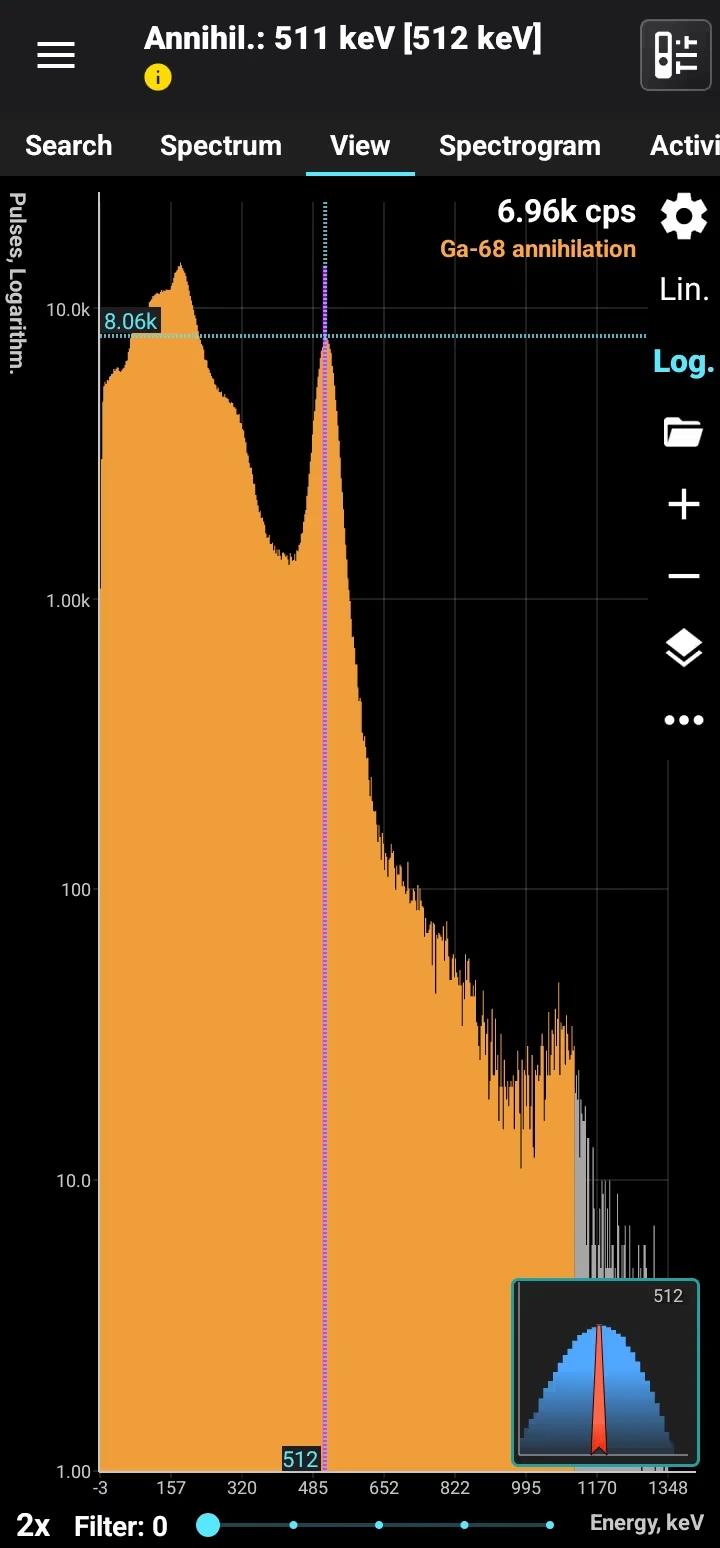
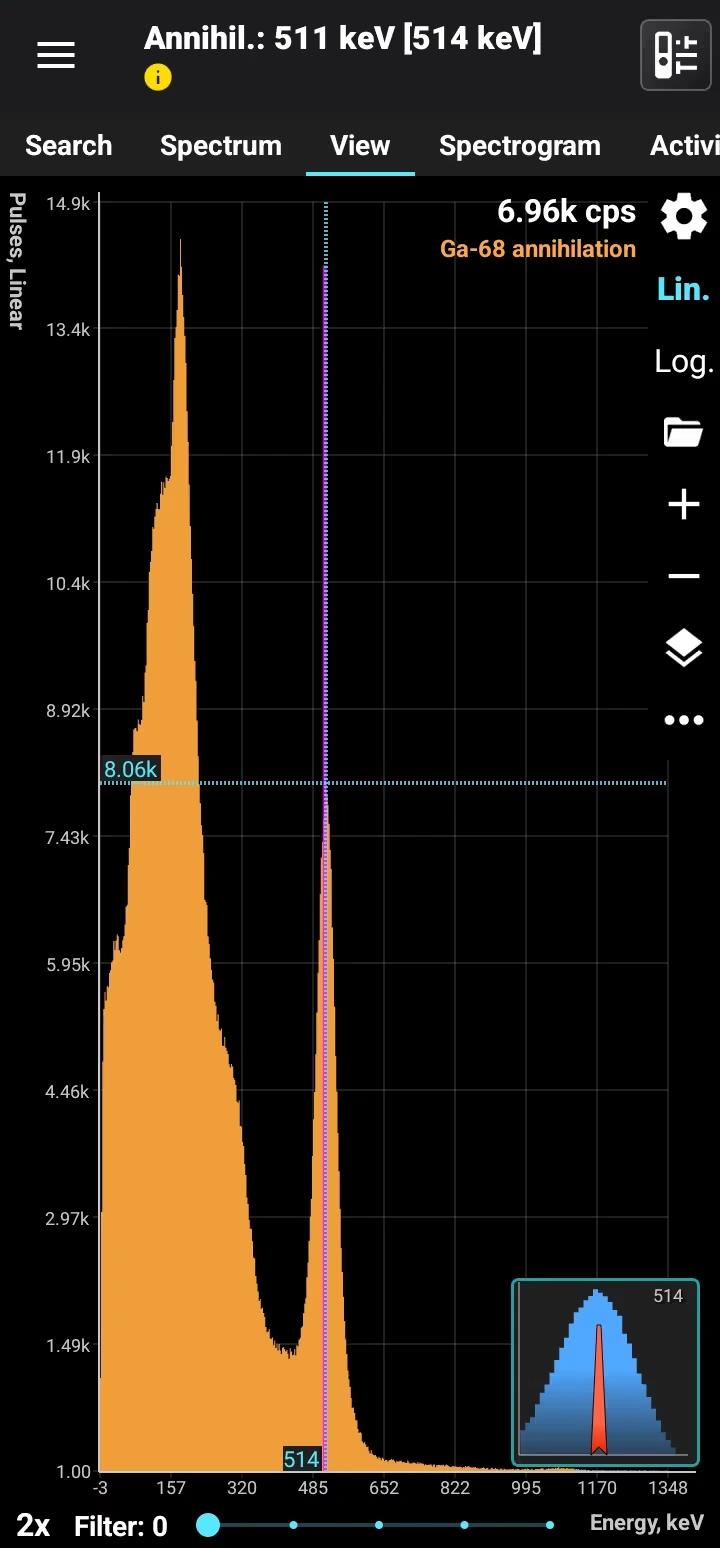
Like F-18, Ga-68 is seen mainly through its 511 keV annihilation line, but the two can be told apart: Ga-68 also emits a weak gamma line at 1077 keV (3.2% of decays), which appears as a small peak once enough counts are collected, while F-18 has no gamma lines at all. The half-lives are a second clue — 68 minutes for Ga-68 against 110 minutes for F-18.

Ga-68 is widely used in nuclear medicine, particularly in PET imaging. It is a key isotope in radiopharmaceuticals for diagnosing cancer and other diseases. Ga-68-labeled compounds, such as Ga-68 DOTATATE and Ga-68 PSMA, are used for imaging neuroendocrine tumors and prostate cancer, respectively. These radiopharmaceuticals target specific receptors or antigens, enabling high-resolution imaging to detect and stage diseases with great accuracy, and they form theranostic pairs with the corresponding Lu-177 compounds (Lu-177 DOTATATE, Lu-177 PSMA) used for therapy. The short half-life of Ga-68 allows for rapid imaging while minimizing radiation exposure to the patient.

Ga-68 is not naturally occurring and is produced artificially. It is typically extracted from germanium-68/gallium-68 generators, which are used in hospitals and medical facilities. These generators provide a reliable on-site source of Ga-68 for radiopharmaceutical preparation. Due to its short half-life, Ga-68 is encountered only in controlled medical and research environments, and its production and use are strictly regulated to ensure safety and efficacy in clinical applications.
For Radiacode users the usual encounter is a patient after a Ga-68 PSMA or DOTATATE PET scan: with 100–200 MBq injected and a 68-minute half-life, such a person is detectable for only a few hours — less than after an F-18 scan — and the spectrum shows the 511 keV peak with a small 1077 keV companion. Another case is a sealed Ge-68 source used to calibrate PET scanners: its daughter Ga-68 is in equilibrium with the 271-day Ge-68, so the source behaves as a long-lived 511 keV emitter with the same weak 1077 keV line.
Ga-68
Gallium-68
Half-life: 68 minutes Main emission lines: 511, 1077 keV
Decay mode ec Beta+
Beta+
| Avg. En., keV | Intensity, % | Decay En., keV |
| 836.0 | 87.72 | (2921) |
| 352.6 | 1.19 | (1843.7) |
Gamma
| Energy, keV | Intensity, % |
| 1077.34 | 3.22 |
| 1883.16 | 0.137 |
| 1261.08 | 0.0943 |
| 805.83 | 0.0940 |
| 578.52 | 0.0335 |
Annihilation
| Energy, keV | Intensity, % |
| 511.0 | 178 |
X-rays
| Energy, keV | Intensity, % |
| 8.639 | 2.757 |
| 8.616 | 1.418 |
| 9.569 - 9.652 | 0.592 |
| 0.883 - 1.187 | 0.152 |