
Titanium-44 (Ti-44) is a radioactive isotope of titanium with a half-life of approximately 59.1 years. It decays by electron capture to scandium-44, emitting two low-energy gamma rays at 67.9 and 78.3 keV in almost every decay; on a CsI(Tl) detector these merge into a single peak around 73 keV. The daughter Sc-44 (half-life 4 hours) then decays by positron emission, so a Ti-44 source in equilibrium with its daughter also shows the 511 keV annihilation peak and the 1157 keV gamma line of Sc-44. The long half-life of Ti-44 makes it useful as a parent nuclide for generators and as a stable long-lived calibration source.

Titanium-44 is the parent isotope for scandium-44 used in medical diagnostics. Scandium-44 is too short-lived (about 4 hours) to be shipped from nuclear centres to hospitals, so Ti-44/Sc-44 generators are delivered to medical centres instead; as Ti-44 decays, the accumulated Sc-44 is eluted from the generator chemically and used for PET imaging.
In science, Ti-44 is important in astrophysics and cosmology. It is a key isotope for studying supernova remnants, as its presence provides valuable information about the nucleosynthesis processes that occur during these stellar explosions: its 68 and 78 keV lines and the 1157 keV line of its daughter were detected in the Cassiopeia A remnant by the NuSTAR and INTEGRAL space telescopes. Sealed Ti-44 sources are also sold as long-lived calibration sources for gamma spectrometers and PET systems, providing the 511 and 1157 keV lines for decades without replacement.

In nature, Ti-44 is not found in significant quantities, as it is produced primarily in supernovae. On Earth, it is synthesized artificially in particle accelerators, mainly by proton irradiation of scandium, but its production is rare and specialized. Ti-44 is generally encountered in controlled research environments, in nuclear medicine departments that use Ti-44/Sc-44 generators, and as sealed calibration sources in laboratories.
With a Radiacode a Ti-44 source gives a characteristic set of peaks: the merged Ti-44 peak around 73 keV, the strong 511 keV annihilation peak and the 1157 keV line of Sc-44, and, with the source held against the crystal, a sum peak at 1668 keV. The low-energy peak distinguishes it from a plain Sc-44 or Na-22 source.
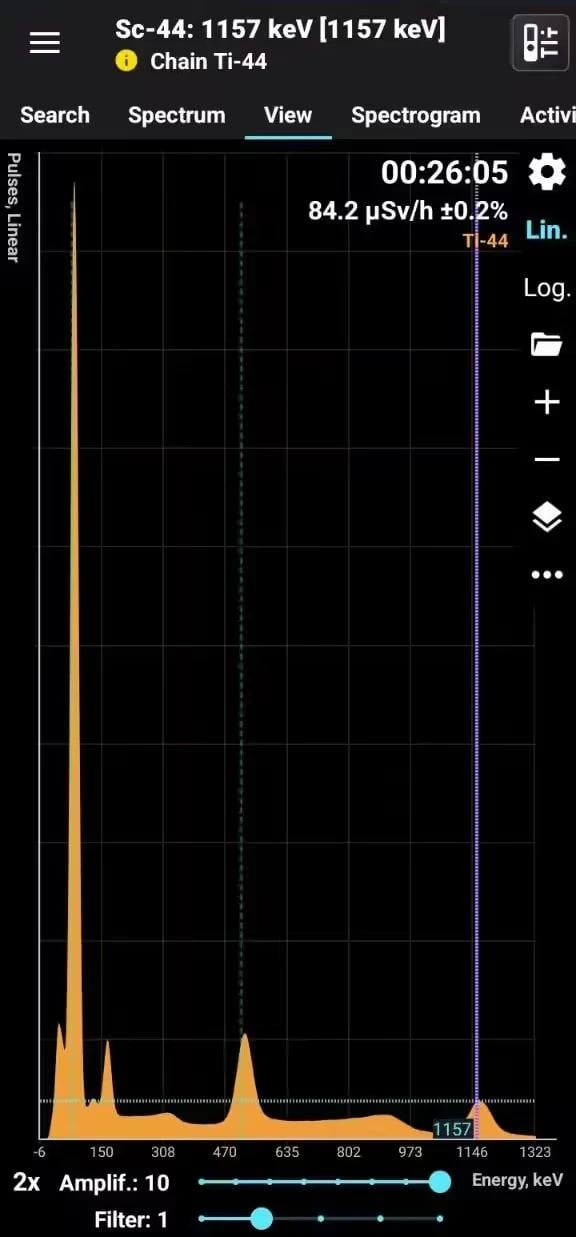
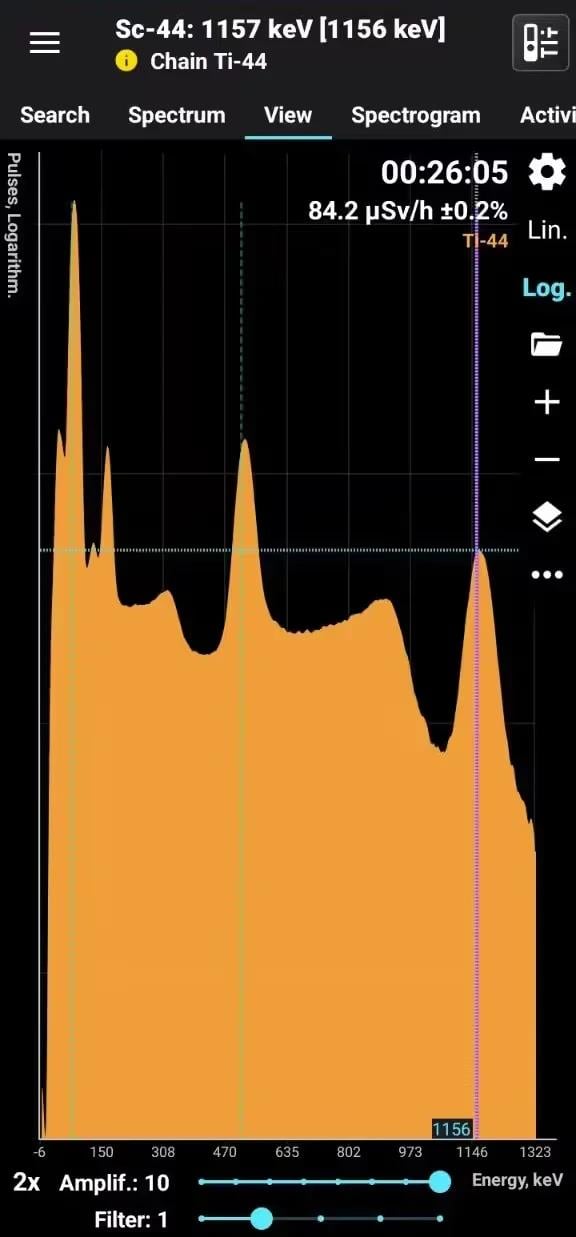
Ti-44
Titanium-44
Half-life: 59.1 years Main emission lines: 68, 78 keV Related lines: 511, 1157 keV (Sc-44)
Decay mode ec
Gamma
| Energy, keV | Intensity, % |
| 78.3234 | 96.8 |
| 67.8679 | 93.0 |
X-rays
| Energy, keV | Intensity, % |
| 4.091 | 11.3 |
| 4.086 | 5.74 |
| 4.461 - 4.486 | 2.25 |
| 0.348 - 0.495 | 0.45 |